Agricultural Drones
DJI M400 Drone Review: Specs, Features, and Hands-On Comparison with the M350
G’day from the Shed
I just got my hands on the brand-new DJI M400, and I figured I’d do what I always do: open the box, have a play, and share my thoughts straight up, no fluff.
I’ve been running the M350 solidly—love that machine—but this M400? Mate, this thing looks like a beast. So I thought I’d take you through what’s in the box, how it compares side-by-side, and give you a real-world, jobsite-level breakdown from someone who uses these things out in the wild—not in a showroom.
First Impressions: Big, Bold, and Built Like a Tank
So straight out of the box, this thing is built different. Slightly taller, heavier, chunkier. Not just for the sake of it—everything feels like it’s there for a reason. From the reinforced arms to the rotor layout, it’s got that “ready for anything” vibe.
The case itself has been upgraded too. You get proper foam cutouts to hold the rotors in place so they’re not flapping about when you’re bouncing through the bush in the 4WD. That might sound like a small thing—but when you’re out in the middle of nowhere, that kind of detail saves headaches.
What’s in the Box
- The M400 drone (with protective motor covers)
- The new controller (slightly updated from the M350/M30)
- Battery station (BS100) and three TB100 batteries
- Spare ports, mounting gear, and all the bits and pieces
I didn’t go through everything with a fine-tooth comb—more of a “figure it out as we go” job. That’s how I roll.
Weight, Size, Feel
You do notice the extra weight. It’s not crazy, but you feel it. The rotors are broader. The motors—easily 20 to 30% bigger than the M350. The legs are chunkier. It just looks and feels tougher. If the M350 is a Hilux, the M400 is a 79 Series Cruiser with a lift kit.
Biggest Upgrade? The Brains and Eyes
Now let’s talk Lidar. On top of the M400 is a 360° rotating Lidar sensor. You’re flying 60 ks an hour, and this thing can spot a 12mm powerline and pull up before it hits. That’s insane. Add in mmWave radar and you’re looking at obstacle avoidance on a whole new level. Makes the vision sensors on the M350 look basic by comparison.
And here’s the kicker: if it sees something—like a transmission line—it doesn’t just beep at you. It rises, moves over it, and keeps flying the mission without stopping. That’s the sort of intelligence that’ll save you thousands in downtime or damage.
Specs Breakdown
- Range: 40 kilometres (yep, four-zero)
- Flight Time: Up to 59 minutes on one battery
- Payload: 6kg capacity, up to 7 gimbal ports
- Battery: Hot-swappable thanks to an internal capacitor
- Speed: Up to 90 km/h for mapping missions
- OS: Fully updated with smoother mission execution
The battery hot swap is a game changer. You’ve got around 40 seconds to swap it out without powering down. No reboot, no fuss. That’s brilliant.
M400 vs M350 – Side-by-Side Thoughts
I lined them up next to each other to really see the difference. Height-wise? Maybe five centimetres taller. Rotor size? Bigger and slightly different pitch. The footprint is definitely larger—but it doesn’t feel clunky.
The M400 feels more stable just sitting there. And the packaging it came in actually supports the rotors better too. In the M350 box, the rotors were floating a bit. Not anymore.
Controller Talk
The controller looks similar to the M350’s—same general shape—but there’s an extra aerial on the back. A2G, plus your 2.4 and 5G antennas. There’s HDMI, USB-A, USB-C, microSD, and even mounting screws for your chest harness. It’s a tidy little unit with just enough new to feel upgraded.
Battery Station – BS100
This new battery station is smart. Three TB100s, silent mode, turbo mode, and keep-warm settings for those cold nights. We had one job where the batteries were warm in the box—felt great on the hands but not ideal for efficiency. This station lets you control that.
Tethered Flight? Yep.
This was a surprise: the M400 supports tethered flight. That means you can hook up ground power and just leave it in the air. For accident scenes, long-duration inspections, or search and rescue, this is massive. Not just cool—practical.
My Personal Take – Who’s It For?
Look, if you’re doing day-to-day inspection work and the M350 is already handling it fine, then no rush to upgrade. But if you’re mapping huge areas, doing precision missions, working in unpredictable environments—or you just want that next-gen tech—this drone is it.
“One job at 90 ks an hour could save you hours of flight time. That’s the kind of feature that pays for itself.”
It’s not just about being flashy. I don’t care for that. I care if it makes my work faster, safer, and more reliable. And from what I’ve seen, the M400 ticks all three boxes.
My Guiding Principles When Choosing Gear
- Simple is better: If I can open the box and figure it out without reading 80 pages of manual, we’re off to a good start.
- Rugged > Fancy: My drones get thrown in trucks, dragged through fences, flown in wind and dust. If it’s fragile, it’s useless.
- Redundancy matters: Lidar, radar, hot swap—give me options. I don’t trust perfect weather or perfect conditions.
- Speed is money: If I can map faster, fly further, and charge less often, that’s real value. Every minute counts out there.
Would I Recommend It?
Look, I’m not here to tell you what to buy. I don’t sell these things. But I do use them—day in, day out. And from what I’ve seen in this first look, the M400 is the next logical step for people who want more power, more precision, and less mucking around.
I’ll be doing more flight testing soon. For now, this is just my out-of-the-box, gut-feel impression. And that gut’s saying: this thing is a game changer.
Still to Come…
We’ve got a double gimbal setup arriving soon. Once that’s in, I’ll run a full payload test and see how it handles with thermal, spotlight, lidar and the works. Should be fun.
Any Questions?
If you’ve got any questions, feel free to leave a comment. Just be nice, yeah? I’m not DJI tech support—I’m just a bloke with a camera, a job to do, and a drone that needs flying. Hope you found this useful.
DJI Mavic 3 Enterprise Multispectral 3M
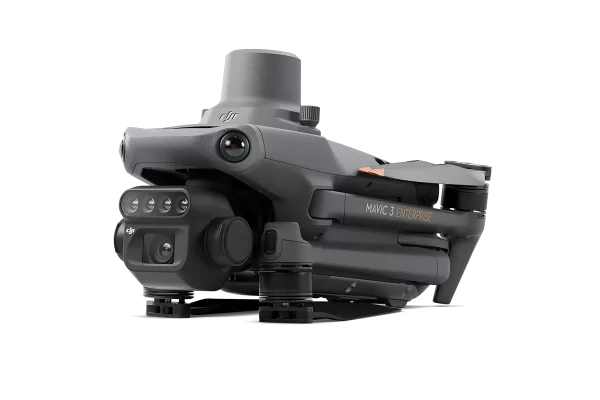
The DJI Mavic 3 Multispectral (M3M) is a compact drone designed for precision agriculture, environmental monitoring, and high-accuracy surveying. It integrates a 20MP RGB camera with four 5MP multispectral cameras, enabling detailed analysis of vegetation health and crop conditions.
Agricultural Applications
Field Scouting: Real-time detection of crop anomalies such as emergence deficiencies, weed pressure, and lodging.
Orchard Mapping: Terrain-follow aerial surveying, tree counting, and 3D route generation using DJI Terra or DJI SmartFarm Platform.
Variable Rate Application: Generation of prescription maps for targeted spraying and fertilization based on vegetation indices.
